Autumn and the Hidden Life of a Japanese Brush
This October, we turn our attention to a detail easily overlooked when we pick up a Japanese brush.
Its character begins with the hair from which it is made.
The animal, the part of its body and the season of collection all influence the finished brush.
Historical accounts of Japanese brush making recall rabbit hair gathered in mid-autumn and prized for fine brush tips.
Seasonal distinctions also survive in the materials used by some brush makers today.
They distinguish between deer hair collected in summer and hair collected in winter.
Deer hair can be used to give strength to the base of the brush head.
These seasonal names offer a small glimpse into the knowledge behind an apparently simple tool.
Another detail may surprise anyone familiar with the term “wool brush”.
In Japanese brush making, this usually refers to goat hair, rather than sheep’s wool.
This hair is valued for its softness, fineness and ability to hold ink.
Even on the same animal, hair from different parts of the body has different properties.
The artisan’s task is to select and combine these qualities.
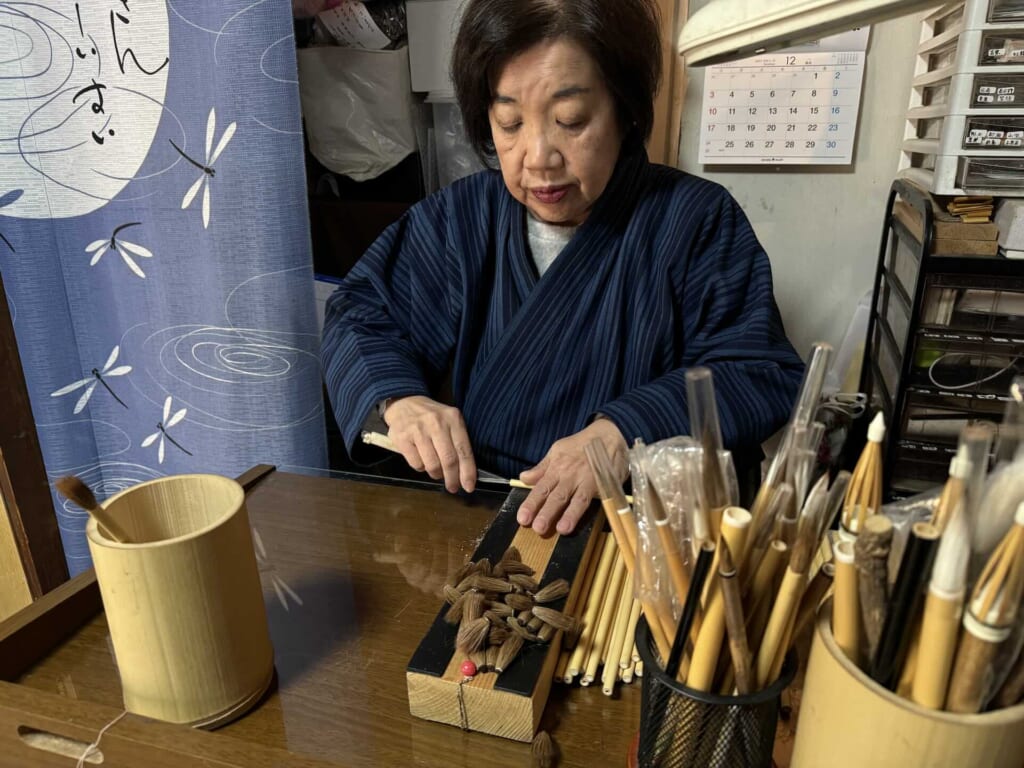
Careful combing removes bent and broken hairs.
Hairs without usable tips, or facing the wrong direction, are also removed.
Different lengths are then blended evenly, while the firmness of the core is adjusted by touch.
The balance within the brush head depends on considerable skill.
During Sumi Journey 2027, we’ll visit the atelier of a master brush maker , Mrs. Tanaka, in Nara. We’ll have the chance to feel different kinds of hair, hear the stories behind these materials and make our own brush. With a little care, it can stay with us for years, bringing back memories of our time in Japan each time we paint.
Margot